
How Australia Stopped Making Things
An economy built on land, rocks, and debt.

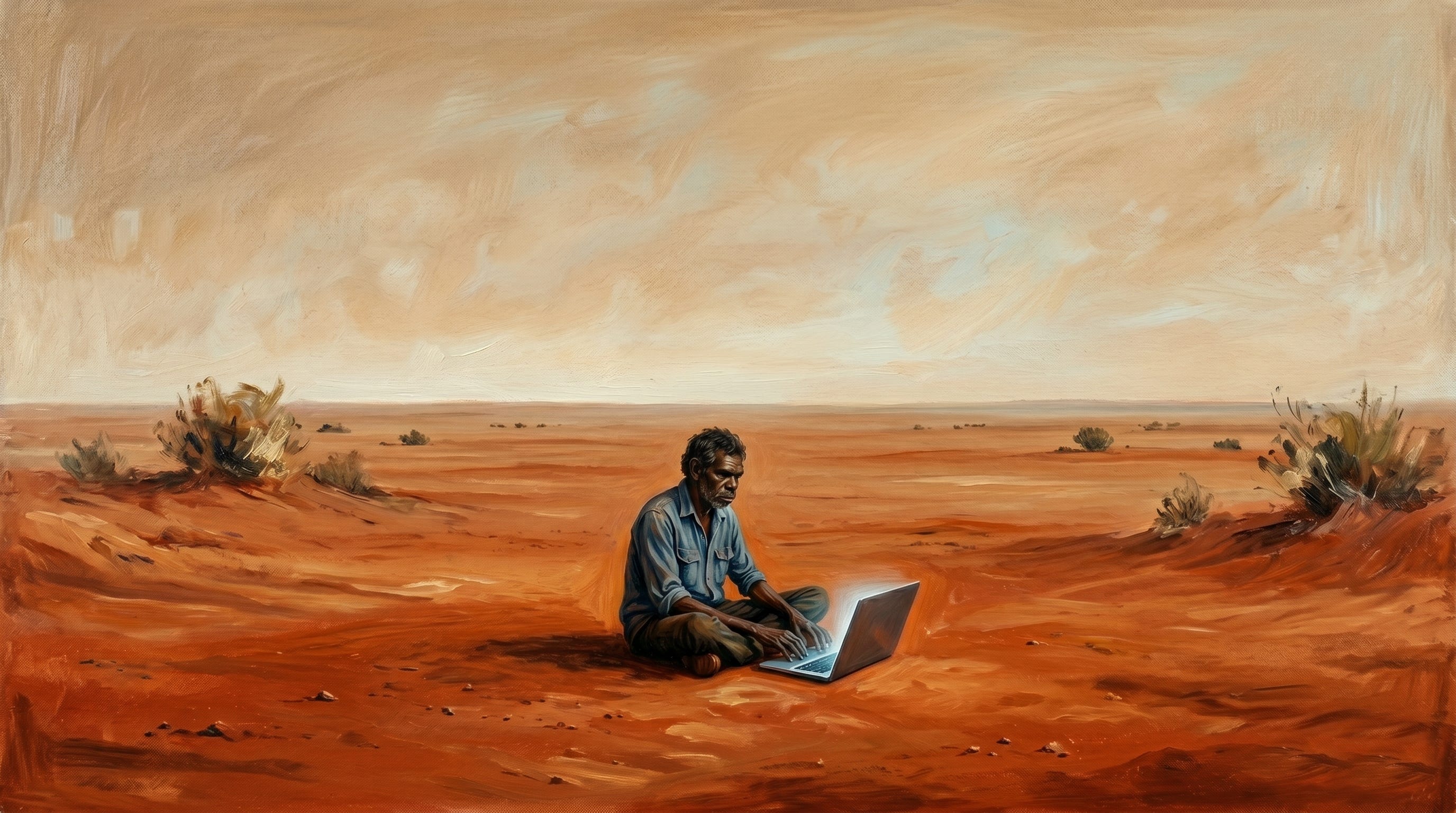
The Adobe charge cleared at 6:14 this morning. $99 per licence for Creative Cloud. Another $30 a month for Acrobat, a PDF viewer so bloated I use it for nothing it wasn’t designed for. Autodesk Revit on subscription. Our project management tools, Xero, Wimi (our client communication platform), Google Workspace. VPSs. All rented. None of it owned. If I stop paying any one of them, everything stops running.
I run an architectural drafting firm. Twenty years ago I worked at my father’s construction company and we owned the servers in the office, the design software outright, perpetual licences sitting on a shelf in a binder. Microsoft Office and Windows were paid for once and used until they were retired. If the internet went down, we kept working. The same industry. The same kind of business. None of those things are true now.
The old escape route from this was self-hosting. Buy your own hardware, run your own stack. AI data centres has made that escape harder. DRAM prices are up 171% year on year, more than gold. That is not production cost. That is supply and demand pricing on captive buyers. Even the workaround is for sale by the month.
This isn’t a tech story. It is the operating logic of the whole economy. Australia stopped making things. We learned to live off the lease instead.
Housing is the obvious one. Most Australians feel it there first. Buying a house in 2026 means borrowing a sum no previous generation would have recognised, paying interest on it for thirty years, and routing the rest of your working life through a Big Four bank. The Big Four hold roughly seventy to seventy-five percent of the mortgage market between them, with their combined home loan book sitting above $1.7 trillion.1 Property dominates their balance sheets to a degree that has no parallel in any productive sector. Their share price, their dividends, their executive pay, all of it tied to housing prices going up, forever, regardless of what that means for everyone trying to get in. The banks are structurally incapable of wanting anything else.
What a buyer can afford and what a job pays no longer meet in the middle. The average first-home-buyer loan now exceeds $560,000, and the time to save a 20% deposit on a median-priced home in Sydney has stretched past six years.2 Among Australians aged 25 to 29, the home ownership rate has fallen to around 36%, down from over 50% a generation ago.3 These are not market fluctuations. They are the lived consequences of a pricing structure designed to reward incumbents.
Look at your power bill. About half is the energy itself. The other half is network charges. The network is the poles, the wires, the substations, mostly built with public money, sold to private operators across the 1990s and 2000s, and now leased back to you with a guaranteed return written into the regulatory framework. Network charges run between roughly 33 and 48 percent of a typical household bill, set by the Australian Energy Regulator under five-year revenue determinations.4 You can switch retailers. You cannot switch wires. The wires charge whatever the regulator allows.
Toll roads. Transurban operates 18 of the 22 private toll roads across Sydney, Melbourne, and Brisbane, including all of CityLink in Melbourne and the bulk of Sydney’s WestConnex network.5 The roads are public infrastructure. The tolls go to a listed company whose prices are locked in by concession deeds running for decades, with annual increases written into the contracts at the higher of inflation or four percent.6 Some of those concessions run to 2060. The political class signed those deeds. You drive on them.
Supermarkets. Coles and Woolworths between them control around 67 percent of the grocery market, with Woolworths at 38 percent and Coles at 29 percent.7 They sell things, which makes them not pure rentiers. The position itself is the rent. Suppliers cannot sell elsewhere at scale. Regional towns with one supermarket cannot shop elsewhere. Margin gets extracted at both ends. The ACCC’s 2024-25 supermarkets inquiry described an oligopolistic market structure in which the dominant retailers had limited incentive to compete vigorously on price, found that both companies had been able to lift retail margins beyond what wholesale price increases required, and identified monopsony power over fresh produce suppliers.8 The inquiry made twenty recommendations. Nothing about the structure changed.
Gambling. Australians lose more per capita than any other country on earth, by a margin so wide it is no longer a contest. Total losses passed $32 billion in 2022-23, around $1,555 per adult, with the second-ranked country roughly thirty percent below us.9 We have less than half a percent of the world’s population and somewhere between 18 and 20 percent of its poker machines. The pokies in pubs and clubs run the bulk of it, legally cartelled in some states and politically protected in all of them. The clubs lobby like a cartel because they are one. The losses are extraction from a captive group, mostly the people who can least afford it. Roughly 84 percent of pokies revenue comes from at-risk gamblers exceeding low-risk thresholds.10
Aged care, childcare, and the NDIS. Privatised social services running on public subsidy. The state pays. Private providers extract margin. Outcomes are often poor. The recipients have no leverage. Their families have no time. The funder is a department.
Universities. International students pay full fees. The fees include a visa pathway and a residency option that is the actual product. Real education happens too, in places. But the financial model is rent on the right to be in Australia, sold by the year, repackaged as tuition. Vice-chancellor pay reflects the model.
Different sectors. Different captive users. Same logic. Position holders extracting from people with no realistic alternative.
“A rentier is an economic actor that owns or controls a scarce asset and that earns income (economic rent) primarily through the limited supply, monopolisation or restriction of access to that asset, rather than through productive activity.”
— Brett Christophers, Rentier Capitalism: Who Owns the Economy, and Who Pays for It? (2020)
This is what economists call a rentier economy. Rent, in this sense, is not your monthly housing payment. Rent is any income that flows to a position regardless of what the position holder produces. The bank earns rent on its market share. The toll road earns rent on its concession. Adobe earns rent on its software lock-in. The pokies club earns rent on its licence. The supermarket earns rent on its shelf space and supplier dependency.
Productive capitalism makes things or delivers services that genuinely add value, in competition with alternatives, where customers can walk away. The rentier economy charges for access to something the customer has no realistic alternative to. The first builds. The second extracts. Australia, the country, used to do meaningfully more of the first. We now do meaningfully more of the second.
The rentier economy didn’t fall from the sky. It was built, brick by brick, by people who knew what they were doing.
Hawke and Keating opened the door in the 1980s with financial deregulation, the floating of the dollar in 1983, and the introduction of compulsory superannuation in 1992. Most of it was probably necessary at the time. Some of it created the architecture that capital and rentier dynamics later fully exploited. Mandatory super in particular created a captive pool of retirement savings that needed to buy something, and what it bought, in large part, was real estate trusts, infrastructure concessions, and bank shares. The system that extracts from working Australians is partly funded by working Australians’ own retirement savings.
Howard and Costello cemented it. The 1999 capital gains tax discount halved the effective tax on capital gains for individuals and trusts, and supercharged the property investment economy.11 Negative gearing already existed. The 1999 change made it irresistible. The benefits of the discount were never broadly shared. Modelling has consistently shown that the top 10 percent of households by income receive close to three-quarters of the benefit, with the wealthiest fifth receiving close to 90 percent.12 The privatisation wave moved telecommunications, airports, ports, and parts of the energy networks from public ownership into private rentier portfolios. The mining settlement that survived three governments after them locked in low effective royalties on gas, the resource that should have been our equivalent of the Norwegian sovereign fund.
Rudd tried to change the resource side with the Resource Super Profits Tax in 2010. The mining industry ran a public campaign that ended his prime ministership inside a few weeks.13 Gillard watered it down to the Mineral Resource Rent Tax. It collected almost nothing. Abbott repealed even that. The Petroleum Resource Rent Tax, which is supposed to capture the rents on offshore oil and gas, now generates a single-digit percentage of total industry revenue.14 In 2023-24, Australians paid more in HECS repayments than gas companies paid in PRRT. Four times more.15
The forces underneath the names are familiar. Financialisation, the conversion of every asset into something to be traded and leveraged. Privatisation, the conversion of public infrastructure into private rent streams. Tax preference for capital over labour. Most of the country didn’t notice it happening because their own house was going up in value at the same time.
I am inside this system. So is every Australian reading this. Pretending otherwise is the easy version of the conversation.
I run a business that exists because Australia has built a property economy. My customers are owner-builders, people building or extending homes, often because they cannot afford to buy what they want at market price and the build path is the only way in. My business is downstream of the same dynamics this article is critiquing. If the property economy stopped tomorrow, it would not exist in its current form.
I own my home. The equity I have in it has grown not because I am clever but because the asset class I happened to buy into kept inflating. I have superannuation invested in things, and some of those things are part of the rentier stack this article is describing. I am, in a small way, an asset elite. So is every Australian with a balanced super fund. Roughly two-thirds of households own their home, with or without a mortgage.16 The system runs on the consent of people who think they are its victims and partial beneficiaries at the same time.
That doesn’t make the analysis wrong. It makes the politics complicated. There is no clean us-and-them. Our kids will rent because of the policy stack we voted for. The hypocrisy is everyone’s. Including mine.
There is a left-of-centre version of this argument that I want to engage with rather than dismiss. The Greens, the Australia Institute, large parts of the academic left have been making structural critiques of the Australian economy for years. They have been right about a great deal of it.
They were right that wealth has been flowing to capital and not to labour. The data is unambiguous. They were right that corporate Australia has captured significant pieces of the policy apparatus. The mining campaign that ended Rudd’s prime ministership is the cleanest example. Banking, gambling, aged care, energy retail, all show patterns of regulatory capture. They were right that the housing tax stack is engineered to favour existing asset holders over new entrants. The CGT discount data alone makes the inequity case unanswerable.
They are right about what’s broken. Wrong about what fixes it.
The standard answer from that side of politics is more state. More public investment, stronger regulation, redistribution via taxation. There are decent arguments for some of it. The assumption underneath, that the state is a neutral antidote to rent capture, does not hold up against the Australian record. The privatised infrastructure stack was sold by the state. The gentailers operate inside a regulatory structure designed by the state. The NDIS rent extraction was created by a state programme. International student rent runs through state-licensed institutions. Even the toll roads exist as a problem because state governments contracted them out. The state in Australia is frequently the bridge through which rents are captured, not the wall against capture.
Redistribution treats the symptom. It does not address the productive hollowness underneath. You cannot tax your way out of a country that no longer makes things, because the tax base depends on the things still being there to tax. The Greens version of the answer keeps the rentier structure intact and tries to spread the proceeds more evenly. Better than nothing. Not the diagnosis the analysis demands.
I’m not going to offer the alternative. The honest version of this article stops at diagnosis, not prescription.
But there is one place where the shape of the problem becomes undeniable. Climate.
The honest version of the climate conversation runs into the rentier economy and stops. Australia’s terms of trade, the strength of the dollar, and a meaningful slice of the Commonwealth and state budgets depend on selling fossil fuels and other minerals to Asia. Resource and energy exports were $415 billion in 2023-24, easing to a forecast $383 billion in 2025-26.17 We have not done a serious public accounting of what replaces that if we transition. When the Strait of Hormuz closed in March 2026, we found out we had thirty days of fuel and no refineries. We are not prepared for the present, let alone the transition.
The contrast with Norway is the cleanest case study available. Norway taxes its petroleum sector at a combined effective rate of around 78 percent and channels the revenue into a sovereign wealth fund now worth more than two trillion Australian dollars, somewhere around $389,000 per Norwegian citizen.18 Australia’s Future Fund, the closest equivalent, holds roughly $267 billion. Norway captured about $209 billion of $327 billion in oil and gas industry revenue in 2023. Australia captured about $16 billion of $164 billion. The same industry, the same global market, the same export commodity. One country runs on the rent. The other one collects it.
It is worth dwelling on what “making things” actually meant. Australian manufacturing was around 25 to 30 percent of GDP in the 1960s. It is around 5 to 6 percent now. The Snowy Mountains Scheme employed a hundred thousand people across two decades and built generating capacity we still rely on. Holden made cars in Adelaide. BHP made steel in Newcastle and Wollongong. Kodak made film in Coburg. The CSIRO invented Wi-Fi. We had a domestic shipbuilding industry, a domestic textile industry, a domestic appliance industry, a domestic refining industry. Most of those are gone or hollowed to a token. The productive companies the country can still name. Atlassian, Canva, WiseTech, CSL, Cochlear, Fortescue’s metals processing ambitions. All fit on one hand and most of them are software, which is portable. The houses we build, we mostly build for each other. The minerals we dig, we mostly ship raw. We used to do other things. We used to be good at them too.
“Renewables superpower” has now become a slogan. Unfortunately, it is not a plan that has been costed at the scale required to substitute for fossil exports. The minerals story (lithium, rare earths, and hydrogen) is real but smaller, and most of the rents will accrue to the same kinds of foreign-owned majors and domestic billionaires who own the current resource stack. Changing the colour of the rocks doesn’t change the rentier dynamic.
This isn’t a defence of fossil rents. The climate science is what the climate science is. It is the argument that anyone telling you the transition is fast, free, or politically painless is selling something. We’ve been pretending the cost doesn’t exist for fifteen years. That is how nothing ever changes.
We didn’t decide to become this. We sold pieces of the country while the houses kept going up, and the houses are still going up, and the pieces are still being sold.
Big Four mortgage market share figures vary by source. APRA data and analyst commentary place the combined share at roughly 70 to 75 percent of residential mortgages, with combined balances above A$1.7 trillion. APRA Monthly Authorised Deposit-taking Institution Statistics, December 2025; Mortgage Professional Australia, “Macquarie gains on Big Four as mortgage book exceeds $160bn,” January 2026; The Adviser, “Big 4 post gains in home lending,” August 2025.
Savvy, “Home Loan Statistics Australia,” analysis based on ABS Lending Indicators, January 2026; Domain First-Home Buyer Report 2025; ANZ CoreLogic Housing Affordability Report 2024.
Eden Emerald Mortgages, “Home Ownership Statistics Australia 2026,” citing ABS Census 2021 data on age-cohort home ownership; Australian Institute of Health and Welfare, “Home ownership and housing tenure,” 2025.
Energy Consumers Australia, “What makes up the cost of an electricity bill?”; Australian Energy Regulator, Default Market Offer 2025-26 final determination, May 2025; Australian Energy Council, “Regulated Electricity Prices: A look at network and wholesale costs,” 2025.
The Conversation, “Private toll roads are supposed to save taxpayers’ money, but can have these hidden costs,” April 2026.
NSW Government, “Toll costs by road,” nsw.gov.au; Levinson, “Toll roads charge too much yet we don’t have enough of them,” The Conversation, March 2026.
Australian Competition and Consumer Commission, Supermarkets Inquiry Final Report, March 2025.
ACCC, “Supermarkets Inquiry Final Report” and accompanying media release, “ACCC recommends supermarket reforms to provide better outcomes for consumers and suppliers,” 21 March 2025.
Grattan Institute analysis cited in DB Recovery Resources, “Australia: push for gambling reforms,” April 2026; Tim Costello, Alliance for Gambling Reform, on the second-place country sitting roughly thirty percent below Australia. Per-adult figure of $1,555 from 2022-23 fiscal year data.
The Australia Institute, “Most gambling losses are from at-risk gamblers,” based on the ACIL Allen Tasmanian Social and Economic Impact Study of Gambling, 2025.
Australian Taxation Office, “CGT discount,” ato.gov.au; “Capital gains tax in Australia,” reference entry, March 2026.
NATSEM modelling cited in Austaxpolicy, “Australia’s 50% Capital Gains Tax Discount: Policy Oversight?”; Australian Financial Review, “Australia May End 50% Capital Gains Tax Break,” February 2026, on the wealthiest fifth receiving close to 90 percent of the benefit.
The mining industry’s 2010 advertising campaign against the Resource Super Profits Tax cost approximately A$22 million and is widely credited with catalysing Rudd’s removal from the prime ministership. Pearls and Irritations, “Australia: the land of lost revenue,” May 2024.
PRRT collected $900 million in 2021-22, equivalent to a sub-1 percent royalty on offshore oil and gas. Michael West Media, “A tale of two fossil superpowers,” May 2023; The Australia Institute, “Norway shows how Australia can get a fair return from oil and gas,” 2024.
The Australia Institute analysis cited in Discovery Alert, “Norway’s Resource Taxation Model: Lessons for Australia,” November 2025.
Australian Bureau of Statistics, Census 2021; Australian Institute of Health and Welfare, “Home ownership and housing tenure,” 2025.
Department of Industry, Science and Resources, Resources and Energy Quarterly, December 2025.
The Australia Institute, “Norway shows how Australia can get a fair return from oil and gas,” 2024; Discovery Alert, “Norway’s Sovereign Wealth Fund: $2.1T Global Leader,” November 2025; SBS News, “Norway has tried it, and now potentially Canada,” April 2026.